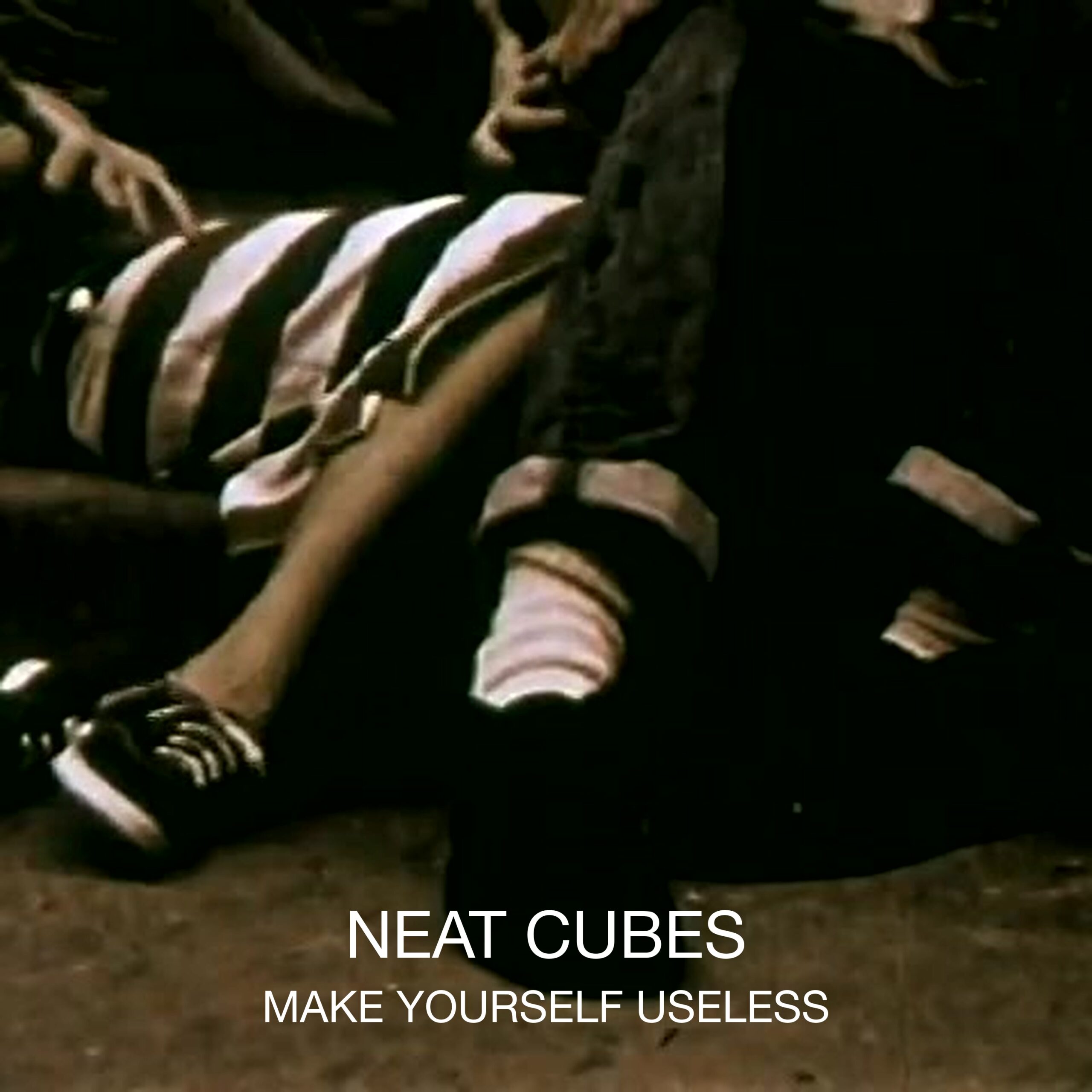
“Make Yourself Useless” by Neat Cubes is out now on Bandcamp. The instrumental song has a slow DIY disco funk feel, with psychedelic effects, an electronic interlude, and some clanking cutlery. It grooves for 2 minutes and 56 seconds, which is a nice computery kind of number. Not relevant, but mentioned anyway.

Buy “Make Yourself Useless” by Neat Cubes from Bandcamp.
Support Indie Music!
If a survey was carried out, i reckon 80% of the people surveyed would say, “yeah, that’s alright, that is”. But the only way anyone will hear it is, and here’s my plan, if i start a war (in vogue these days), build a prison camp (a nice one, more like a wellness holiday camp, take lots of prisoners, and play it to the prisoners. Just once, or perhaps once every while. That’s all.
The song, Neat Cubes say, way created by magic. Took absolutely no effort at all. But the video, just like the last few releases, there’s panic to put some sort of video together. With no budget, and being cameraphobic, we asked our friend – Brian (not his name because you’d think ‘slop’, but it’s not like that. It’s a collaboration, really!): the Neat Cubes provide an idea, me and Brian develop it, and then spend a good few hours making it happen.
The last few videos did not capture hearts and minds, so a different approach this time. We used an VDJ app called VDMX, a few public domain archive clips, and some captions. The result, it’s hardly groundbreaking, but with time, experience, and now with Brian’s input, we can surely do something pretty crazy. Here’s the technical bit:
Making a Music Video with Brian, VDMX6, and Found Footage
The setup: we got Brian to control VDMX6 (a real-time video mixing app) via OSC messages sent from Python. Four video layers are loaded โ three public domain archive clips from the Prelinger Archives (Greenwich Village 1960, Family Scenes 1963, Classic TV Commercials 1948) and one pre-built “punctuation reel” containing title cards, white/red flashes, and strobes timed to key moments in the song. Brian analyses the master audio’s energy profile to identify structural moments, then writes a choreography script that plays the song and sends precisely timed opacity commands to fade layers in and out.
The process: After several iterations we learned that dissolve-blending multiple archive clips creates visual mush โ the similar textures cancel each other out. A small breakthrough was switching to hard cuts: one layer at 100% at a time, cycling every 6โ8 seconds, with the punctuation reel slamming in at key musical moments (text cards like “MAKE YOURSELF USELESS”, “STOP”, “WHY”, white/red flashes, black-and-white strobes). The final performance was recorded from VDMX6, trimmed, and had the master audio muxed in via FFmpeg. A YouTube version (1280×720) and Instagram portrait version (1080×1920, with a slow horizontal pan) were rendered. Album artwork was generated by extracting frames from the archive footage and overlaying text.
My comment: So we have Brian (ok, Claude) choreographing (this isn’t realtime control, it plans it out in advance..) the opacity of the various layers, and this could be extended to any other parameter that can be controlled by OSC. Which is great, but we’re yet to push any boundaries, let along create something that visually amazing. But early days yet. I’m thinking, why bother getting Claude to do this? Why not just use a controller, or even a mouse to jig things around in realtime as the music plays, and record the output. I’m not sure at this point. But there are other avenues to investigate here. UPDATE: the end result was a mush. So re-did manually. Perhaps next time there’ll be a breakthrough…
Buy “Make Yourself Useless” by Neat Cubes from Bandcamp.
Support Indie Music!
